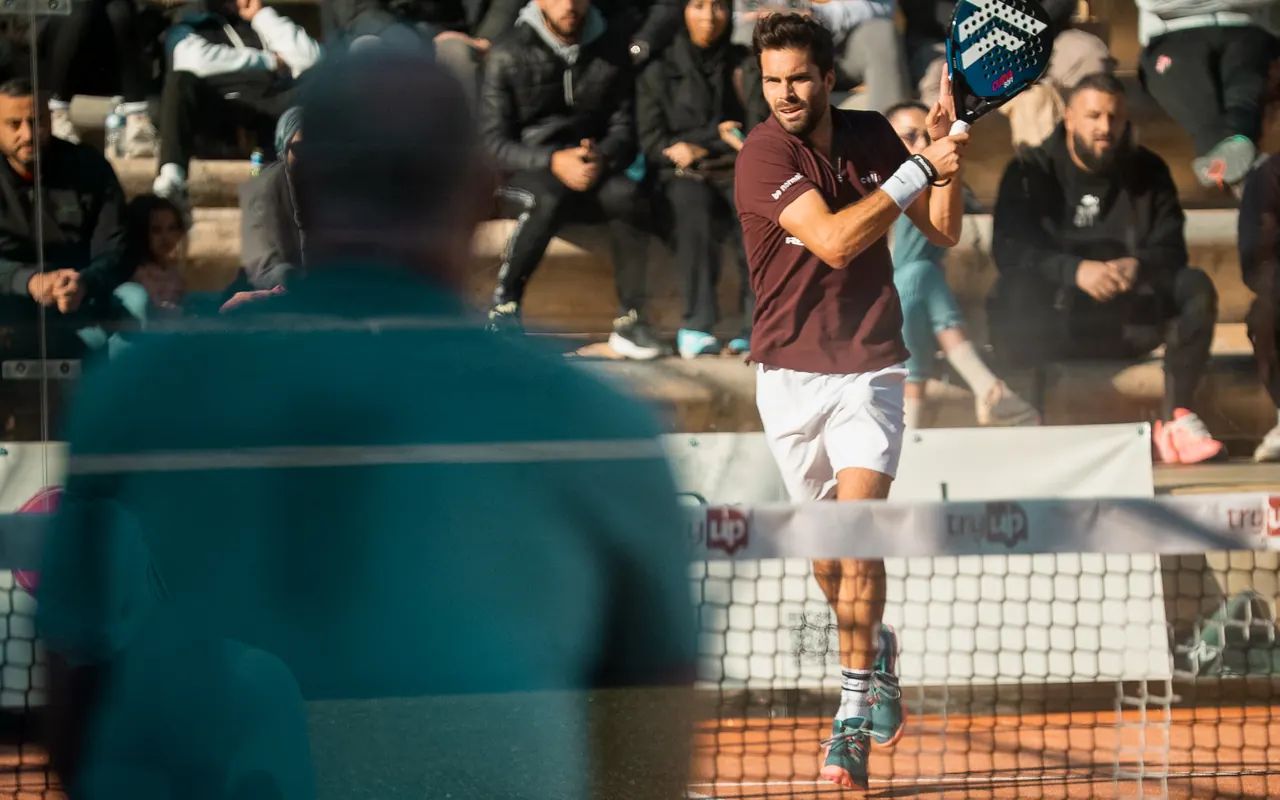
Padel passed 100,000 FFT licence holders in June 2026, +130% in three years, and it has moved into company offsites as fast as onto the courts. Today, organising a padel team building is nothing original. Book the courts, plan the drinks, take two photos for the company LinkedIn: 90% of companies stop there. And they leave the best part on the table.
A well-designed padel day does two things at once. It brings your teams together, and it produces content that works for your employer brand long after the last ball. This guide gives you the formats, real budgets and the method to organise your padel team building. And above all, to turn it into a marketing asset instead of an expense forgotten by the following Monday.
Why padel became the #1 sport for corporate team building
A sport anyone can play, with 5 minutes of rules
Padel’s strength comes down to one detail: you can play from the very first game. No years of lessons like tennis, no marathon-level fitness. The glass walls keep the ball in play, the court is small, the rallies last. After five minutes of explanation, a complete beginner is hitting their first balls and winning their first points.
For team building, that changes everything. The 28-year-old sales rep and the 55-year-old finance director end up on the same court, at the same level, laughing at the same mistakes. No other sport levels everyone out so quickly.
The doubles format that builds bonds
Padel is played by four, two against two. You can’t win alone. You have to talk, position yourself, cover your partner, adjust the strategy point after point. It is exactly what you ask of a team at the office, except here nobody notices because everyone is having fun.
That collective dimension is why corporate wellness is worth about $71.9 billion in 2026 and why padel is regularly cited as the ideal team-building activity. HR teams no longer want a karting day where everyone drives on their own. They want a format where people genuinely cooperate.
The groundswell: the numbers that make it a choice of its time
Padel isn’t a niche fad. The Global Padel Report 2026 (PwC for Playtomic) counts 19.4 million players worldwide, 20,900 clubs and 58,300 courts, with 91,000 courts projected by 2028. France has more than 3,400 courts and new clubs open every month.
Offering your teams a padel team building in 2026 means giving them the sport everyone is talking about, at the moment everyone is talking about it. The novelty effect works in full, and it works for your employer brand.
The 4 padel team-building formats (and which to choose)
Not all padel team buildings are alike. The right format depends on your goal, your budget and how many people you are bringing together. Here are the four options that cover most needs.
The padel afterwork (2 to 3 hours): the discovery format
The simplest way to start. A late afternoon, booked courts, a hosted introduction, a drink to finish. Ideal for a first time, a small team or a modest budget. It is the format that defuses reluctance (“I’ve never played”), because the barrier to entry is zero.
The offsite day: padel and strategy workshops
A half or full day alternating padel and work time. In the morning you frame your quarterly goals in a meeting room. In the afternoon you head down to the court. Sport becomes a breather between thinking sessions, and the cohesion built on court carries over into the evening conversations.
The 2-3 day offsite (France, Spain or Portugal): conventions and kick-offs
For an annual convention, a sales kick-off or a leadership retreat. You go away for two or three days to a venue with courts, often a hotel or resort with one or more. Padel structures the stay, and the change of scene amplifies the impact. It is the most complete format, and the one that produces the most usable content.
The inter-team or client tournament: internal cohesion and client relationships
A tournament puts stakes and conviviality in the same place. Internally, it pits departments against each other. Externally, it becomes a powerful client relationship lever: inviting your best accounts to a padel tournament beats yet another lunch. If you want to build a real competitive format, our guide to organising a padel tournament covers the mechanics from A to Z.
How much does a padel team building cost? 2026 ranges
It is always the first question. Here are real benchmarks from the French market in 2026, excluding options.
2.5-hour afterwork: about €45 to €85 excl. VAT per person
For around twenty participants, allow €900 to €1,700 for court hire, hosting and coaching. It is the entry level, perfect for testing the format before investing more.
6-hour day: about €120 to €180 excl. VAT per person
For around thirty people, the budget is about €3,600 to €5,400. That generally covers courts for the day, hosting, refereeing, and often food.
What a “court only” price never covers
And this is where most companies get the maths wrong. The ranges above pay for the sport: courts, balls, coach. They don’t pay for video capture, editing or distribution. In other words, they pay for a day’s experience, but not for the asset that day could become. The difference between a team building that costs and one that pays back is made precisely on the line nobody budgets.
The mistake 90% of companies make: forgetting content
A padel day is a free shoot nobody uses
Put 30 employees on a padel court. You get genuine smiles, spectacular rallies, moments of complicity no creative brief could manufacture. It is raw material for your communications, and it is already paid for. Yet in the vast majority of cases, it all ends up in someone’s phone camera roll and never comes out.
The 3 uses of a filmed padel team building
Captured well, a padel team building feeds three workstreams at once.
First, employer brand: an authentic team video is worth every speech about “company spirit” in a job ad. Second, recruitment: a candidate who sees your teams having a great time together pictures themselves more easily than in front of a salary grid. Finally, social media: short clips feed the company’s and employees’ LinkedIn, where your future talent spends its days. On distribution, our guide to running your social media gives the full framework.
What a filmed format really produces
We are not talking about empty promises. With our P500 Coached Business format, a filmed padel event for a company, our client Limova generated 187,000 views and 31 minutes of cumulative attention from a single activation. The details are in the Limova case study. For a B2B player, the same mechanism took Sol Sportif to 310,000 views and several qualified leads, as you can read in the Sol Sportif case study. Sport creates the emotion. Content makes it last.
How to run a successful padel team building: the 7-step checklist
1. Set the goal
Before booking anything, decide: do you want to bring a team together, look after clients, or feed your employer brand? All three are possible, but the main goal dictates the format, the venue and the capture setup. A day designed for recruitment isn’t filmed the same way as an afterwork between colleagues.
2. Choose the format and the number of participants
For cohesion, the right size is between 16 and 32 people. Below that, group energy drops quickly. Above it, you need more courts and more supervision so nobody sits on the bench. Calibrate the format to that sweet spot before sending the invitations.
3. Find the right venue
Three options: a city club for a quick afterwork, a hotel with a court for a residential offsite, a resort for a full stay. Check how many courts are available: nothing is worse than a rotation where half the group waits its turn.
4. Frame the hosting
A good padel team building isn’t self-service court hire. Plan an introduction for beginners, light refereeing, and teams mixed by level so nobody feels left behind. The host makes the difference between a flat day and a memorable one.
5. Plan capture from the brief
This is the step everyone skips, and the one that changes the return. Decide on the photo and video setup before the event, not that morning. A camera operator who knows what to film (key points, reactions, portraits) brings back usable material. A colleague with their phone brings back shaky footage.
6. Put the content to work
When the day ends, the work begins. Edit the clips, plan internal and LinkedIn distribution, give employees the visuals to reshare. A padel team building told over three weeks is worth ten times the same day summed up in one post the next morning.
7. Measure
Track what matters: engagement on the posts, spontaneous applications in the following weeks, mentions by your teams. You will then know whether your padel day was an expense or an investment, and what to improve next time.
Padel and hospitality: the rising offsite combo (MICE)
Why hotels with a court are becoming offsite hotspots
Business travel has rediscovered sport, and hotels have noticed. More and more properties are installing a padel court to attract company offsites, because the format ticks every box: social, photogenic, accessible. For you as an organiser, it is a chance to bring accommodation, food and activity together in one place. We covered this trend from the venue side in our article on hotels with a padel court.
The padel offsite package: accommodation, court and content in one place
The winning combination for a two-day offsite looks like this: a hotel with one or more courts, a hosting team and built-in capture. You arrive on Thursday, work and play on Friday, and leave on Saturday with decisions made, teams reconnected and a bank of content ready to publish. Everything is in one place, and everything serves your brand.
FAQ
How much does a corporate padel team building cost?
Allow about €45 to €85 excl. VAT per person for a 2.5-hour afterwork (€900 to €1,700 for 20 people), and €120 to €180 excl. VAT per person for a full day (€3,600 to €5,400 for 30 people). These ranges cover the sport and hosting, not video capture or content production.
How many participants for a padel team building?
The sweet spot for cohesion is between 16 and 32 people. Below that, group energy drops. Above it, you need more courts and supervision so participants don’t wait their turn.
Do you need to know how to play padel?
No. Padel takes five minutes to learn, which makes it the ideal sport for a mixed-level group. Beginners and experienced players quickly end up on an equal footing, especially with an introduction at the start.
What padel offsite formats are there?
Four formats cover most needs: the afterwork (2 to 3 hours), the offsite day (padel and workshops), the 2 to 3-day offsite in France or abroad, and the inter-team or client tournament.
Can you run a padel offsite at a hotel?
Yes. More and more hotels and resorts are adding padel courts for business travel. The “offsite package” brings accommodation, food, court and capture together in one place, which simplifies the organisation.
How do you reuse a padel team building as content?
By planning capture from the brief. A well-filmed day feeds your employer brand, recruitment campaigns and social channels for weeks. That is precisely what separates an event that costs from one that pays back.
And after the last ball?
Padel has become the best playing field for bringing a team together. But getting your people onto a court is only half the job. The other half, the one almost nobody does, is turning that day into content that serves your brand long after everyone has gone home.
Organising a padel offsite or team building? Let’s talk about how to turn it into content that keeps working for your employer brand long after the last ball.